


"Taxi" Title Brand, What Buyers Should Know

- "Taxi" Title Brand, What Buyers Should Know
- What Is a "Taxi" Title Brand?
- How a Vehicle Gets a "Taxi" Title Brand
- How States Handle the "Taxi" Title Brand
- Common Characteristics of Former "Taxi" Vehicles
- Pros and Cons of Buying a Prior "Taxi" Vehicle
- How to Identify a Vehicle That Was a "Taxi"
- Tips for Inspecting and Purchasing
- FAQs About The "Taxi" Title Brand
- FREE Vehicle Search
A vehicle title provides crucial information about a vehicle's ownership and background. A brand may be applied to the title when something significant occurs, such as specialized usage or considerable damage. A title brand is a permanent notation applied to the title certification by a state motor vehicle agency. These designations range from "Collision" to "Fire Damage" or note specific commercial uses such as "Former Rental" or "Agricultural Vehicle". The brand helps call attention to elements of a vehicle's past, worth reviewing before purchase.
While "taxi" is a well-recognized term, a "Taxi Title Brand" may be less familiar. Sometimes written as "Original Taxi" or "Prior Taxi", these notations indicate that a vehicle was once used to carry paying passengers. This designation matters because taxis are usually driven long hours and accumulate high mileage. Given these factors, some states require a corresponding title brand, while others simply record taxi status through the vehicle registration.
Knowing how the Taxi Title Brand works and differs from a simple registration code can help buyers better evaluate high-mileage used cars. This essential understanding can prevent surprises when dealing with financing, insurance, or resale values.
What Is a "Taxi" Title Brand?
A Taxi Title Brand is an official notation on a vehicle's title or electronic record confirming prior use as a licensed taxicab or for-hire passenger vehicle. It's a consumer disclosure, much the same as "Theft-Recovered Vehicle" or "Salt Water Damage" title brands. Once applied, the brand becomes a permanent part of that vehicle's title history. In almost all states (Hawaii is under development) and the District of Columbia, this information is submitted to the National Motor Vehicle Title Information System (NMVTIS), a federally run database.
NMVTIS ensures that the title history carries forward, regardless of whether the vehicle is sold or the title is transferred to another state. This system ensures that the designation will still be present even if a previous for-hire vehicle is sold in a state that doesn't use the Taxi Title Brand. This approach prevents title washing and ensures that properly informed buyers know what they're getting.
The mark itself may appear in the "brands", "remarks", or "previous use" field of a printed title, or as an electronic flag in state DMV databases. Some states, such as California and Florida, require that it appear in plain text, while others, including Michigan or Vermont, use an NMVTIS-standardized brand code; in this case, "Prior Taxi" or "Code 17".
No matter how the information is presented, a vehicle with a Taxi Title Brand spent at least part of its life transporting paying passengers. In reality, a Taxi Title Brand is less common than damage-related designations because only a handful of states use it (state-specific details are covered later). Nonetheless, being familiar with this Taxi Title Brand makes you a more informed car buyer.
How a Vehicle Gets a "Taxi" Title Brand
In states that apply the Taxi Title Brand, the process starts when the vehicle is first registered for commercial use. The specific steps may vary by jurisdiction, but the taxi operator must typically provide proof of insurance and verify compliance with safety standards. There may be additional business registration requirements. At this point, the taxi enters service with a permanent commercial record in the DMV's database linked to its vehicle identification number (VIN).
When a taxi is sold, its prior for-hire title status follows. Many states have disclosure requirements, so the taxi company or selling dealer can't legally hide the vehicle's history. Depending on the state, when the car changes hands, the title changes from a standard commercial designation to one with a Taxicab, Prior Taxi, or Original Taxi designation.
As covered, NMVTIS permanently captures title-brand information, ensuring that branded records remain accessible to future buyers even if a former taxi crosses state lines. Here's one scenario where this matters: if a retired taxi from one state is sold and later retitled in another, the new paper title may not display the prior brand. The receiving DMV might not have an equivalent category or could omit it during data entry. However, the branding doesn't disappear in NMVTIS, which retains the original record exactly as reported. That means the Prior Taxi history will still appear in any VIN-based vehicle history report, such as those provided through GoodCar or other NMVTIS-approved data providers.
States take different approaches to handling taxi branding, even though almost all report title data to NMVTIS. In Florida, titles are marked to show when a vehicle was previously used as a taxicab. At the same time, Michigan dealers note the history on the title application, so it becomes part of the state's record. Wisconsin follows a similar process, and Vermont includes "Prior Taxi (Code 17)" among its official brand codes. Virginia once required an "Original Taxi" label, but that practice ended in 2019, and the mark now appears only on older titles or within NMVTIS records.
How States Handle the "Taxi" Title Brand
How states handle taxi branding isn't uniform. Each DMV has its own way of recording and displaying a vehicle's commercial past, even though all report the data to NMVTIS. Some mark it directly on the printed title, while others capture it electronically or through dealer paperwork. The result is a patchwork system, what shows up on one title might not appear on another, even when both vehicles share the same history. Here's how select states manage the Taxi Title Brand.
State |
Brand / Designation |
How It's Applied |
|---|---|---|
California |
"Original Taxi" / "Prior Taxi" |
Brand printed on title and stored in DMV records. |
Florida |
"Taxicab" prior use |
Required disclosure under §319.14; appears on every subsequent title. |
Michigan |
"Taxi" indicator |
Applied to the RD-108 dealer application; carried state and NMVTIS data. |
Vermont |
"Prior Taxi (Code 17)" |
Appears on printed title; defined in DMV's brand-code directory. |
Wisconsin |
"Previously licensed and used as a taxicab or for public transportation" |
Required by statute §342.11(1). |
Virginia |
"Original Taxi" (historical) |
Issued before 2019; remains on older or out-of-state titles. |
Other states, like New York, Massachusetts, Texas, and Illinois, take a different route. Instead of title branding, they oversee taxi and livery vehicles through registration. A car might be classified as "For Hire", "Livery", or "Taxi" while it's in service, but once that registration expires and the vehicle is sold, the paper trail usually stops at the title. The most reliable way to spot that history later is to check NMVTIS-backed vehicle-history data. You can also sometimes confirm a taxi-use history through past registration records, insurance documentation, or physical clues from fleet equipment.
This piecemeal approach results from how state systems developed long before NMVTIS connected the dots. For buyers, the bottom line is what each state shows you. In places like California or Florida, the title makes it clear if a car was once used as a taxi. But in states such as Massachusetts or New York, that detail usually isn't on the title at all, you'll need to run the VIN or check past registration or service records to find out whether the vehicle ever worked for hire.
Common Characteristics of Former "Taxi" Vehicles
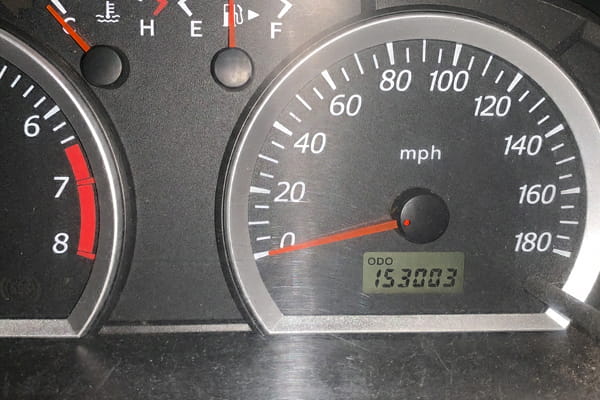
It's no secret that taxis and for-hire vehicles are driven differently than ordinary cars. That heavy use shows up in a few obvious ways.
-
Extreme High Mileage: While most cars are considered high-mileage around 150,000 to 200,000 miles, taxis can easily double that. The average New York City cab logs 50,000 to 60,000 miles a year, roughly four times what the typical U.S. driver covers, according to the Federal Highway Administration.
-
Interior Wear: Long hours on the road mean seats, flooring, and controls wear down quickly. Upholstery often shows cracks or flattening, and high-touch areas like door handles or steering wheels may be smooth from overuse.
-
Mechanical Fatigue: Stop-and-go driving, idling, and carrying passengers take a steady toll. Cooling systems, suspension parts, and brakes face more strain than those in personal vehicles.
-
Corrosion and Exterior Wear: Constant exposure to the elements, salted winter roads, heavy rain, and sun, fades paint and invites rust, especially underneath the car.
-
Visible Modifications: Holes or wiring from removed meters, partitions, or rooftop lights often remain, along with uneven paint where decals once sat.
Fleet taxis can be on the road almost nonstop, sometimes shared among drivers on different shifts. All that time behind the wheel has an impact: long idling heats the engine bay, stop-and-go traffic wears out brakes and suspension parts, and doors that never get a rest eventually start to sag or rattle. Inside, you'll usually see the years of passenger use, scuffed panels, worn seat fabric, and hard-wearing trim picked more for durability than looks.
Buying a used car with a Taxi Title Brand isn't automatically a bad purchase, but be prepared for extra maintenance due to a heavy service life. You'll want to dive deeply into the vehicle's service records, which a trusted mechanic should also review. Don't be surprised if you encounter a rebuilt engine or transmission; that's not always a red flag.
Pros and Cons of Buying a Prior "Taxi" Vehicle
Knowing the trade-offs of buying a car with taxi history can lead to a better purchasing decision.
Pros
-
Lower Price: High mileage and a branded title can make retired taxis a bargain against comparable clean-title counterparts with less usage.
-
Proven Durability: Fleet vehicles often come from the factory with heavy-duty components, such as reinforced suspensions, larger cooling systems, and upgraded brakes. Some taxis may also have aftermarket upgrades to support constant driving.
-
Documented Maintenance: Professional fleets usually receive ongoing maintenance, validated by detailed service logs.
Cons
-
Excessive Wear: Hundreds of thousands of miles on city and suburban streets push the longevity of the engine, transmission, suspension, and other critical systems. Rebuilt systems may not be as robust as factory-original components.
-
Cosmetic Issues: A vehicle's history as a taxi usually leads to worn interior components, faded paint, and residual signs of removed service equipment.
-
Reduced Resale Value: A Taxi Title Brand or taxi-use history and high mileage can limit purchaser interest, making resale difficult regardless of mechanical condition.
-
Financing and Insurance Limitations: Buying a used taxi can be risky, which can discourage lenders and insurers. If available, coverage and loan options may be limited.
The viability of a retired taxi as a used car depends on its mileage, condition, and price. However, what initially appears as a bargain could prove otherwise if extensive repairs are required. Compare the cost of a used taxi against an equivalent vehicle without a for-hire history.
How to Identify a Vehicle That Was a "Taxi"
Based on appearance or who's selling the car (like a taxi company), it may be obvious that a vehicle saw taxi duty. Yet, this may not always be the case. Here's a breakdown of how you can confirm its history. Even if you're certain a car under consideration has a for-hire past, getting a complete picture can give you a negotiating edge.
-
Run a Vehicle History Report: Comprehensive background information from an NMVTIS-approved provider, such as GoodCar, can confirm whether a Taxi Title Brand exists. Similar designations could be marked as Original Taxi or Prior Taxi. The report may also provide sales and accident history.
-
Check Registration History: Ask the seller for past registration paperwork or fleet service records showing whether the car was registered for commercial or for-hire use. If that information isn't available, a VIN-based vehicle history report may still note previous registration types or fleet ownership.
-
Inspect Physical Condition: Telltale signs of taxi use include interior and exterior mounting holes (or patched holes) used to secure equipment, mismatched body panels from previous decals and graphics, and heavy wear on the pedals and driver's seat.
-
Look Under the Hood: Taxis are frequently equipped with auxiliary wiring and larger batteries to support radios and other electronics. Check for the remnants of any upgrades.
Tips for Inspecting and Purchasing

A successful used car purchase starts with a thorough inspection, diligent research, and thoughtful planning. These steps are especially critical when considering a high-mileage vehicle like a taxi. Follow these steps before signing any paperwork:
-
Test Drive Thoroughly: A test drive is the simplest way to determine if a car is worthwhile. Before hitting the road, perform a basic visual inspection and confirm all the lights are functional. Spend at least 20-30 minutes driving in different settings (highways, local streets, and parking lots). Observe drivetrain smoothness, steering play, and braking performance. Pay attention to any vibrations or unusual sounds. If you're satisfied with the results, move on to the next steps.
-
Review Maintenance Records: Service logs may not be available if you're buying through a dealer or auction, but having these records can add confidence to the purchase.
-
Confirm the Title Brand and Registration History: Order a comprehensive vehicle history report that includes title data from NMVTIS. GoodCar supplies this information in an understandable format, along with other vitals such as accident history, vehicle specifications, and odometer readings. Review registration records from the seller.
-
Verify Insurance and Financing Availability: Before handing over any money, confirm that insurance is available for the car. A branded title may limit coverage options or require higher premiums. Check with lenders if you depend on financing to buy the car (some banks won't offer loans on branded-title vehicles).
-
Get a Professional Inspection: A pre-purchase inspection by an experienced mechanic is a worthwhile investment. Spending $150 to $250 upfront can prevent much more expensive problems later. The technician should pay special attention to systems that bear the brunt of taxi service by checking engine compression, transmission function, and suspension wear.
-
Factor in Long-Term Costs: Working with a trusted mechanic (ideally the technician who inspected the car), identify components likely to need replacement now and down the road. Create a budget to determine what this used taxi might cost beyond the purchase price.
-
Negotiate: Use any negative factors (such as a branded title, poor condition, ultra-high mileage, or spotty maintenance) to negotiate a better price.
FAQs About The "Taxi" Title Brand
This article highlights the Taxi Title Brand. Title regulations can vary by state and are subject to change. Always verify the most recent rules through the state motor vehicle agency before purchasing a branded-title vehicle.
- "Taxi" Title Brand, What Buyers Should Know
- What Is a "Taxi" Title Brand?
- How a Vehicle Gets a "Taxi" Title Brand
- How States Handle the "Taxi" Title Brand
- Common Characteristics of Former "Taxi" Vehicles
- Pros and Cons of Buying a Prior "Taxi" Vehicle
- How to Identify a Vehicle That Was a "Taxi"
- Tips for Inspecting and Purchasing
- FAQs About The "Taxi" Title Brand
- FREE Vehicle Search
FREE Vehicle Search
- Accidents
- Problem Checks
- Title Records
- Recalls
- Values
- Specs


-
 InfoPay, Inc. (dba GoodCar) is an Approved NMVTIS Data Provider
-

-
