


Salt Water Damage Title on a Car: Risks & Implications
- Salt Water Damage Title on a Car: Risks & Implications
- What Is a "Salt Water Damage" Title Brand?
- How Does a Vehicle Get a "Salt Water Damage" Title Brand?
- Who Assigns the Title Brand & Where It's Recorded
- Impact of a "Salt Water Damage" Title Brand
- Can a "Salt Water Damage" Title Brand Be Removed?
- Buyer & Seller Responsibilities
- Should You Buy a "Salt Water Damage" Vehicle?
- Statistics & Market Data
- How to Check for Title Brands
- FAQs About "Salt Water Damage" Title Brand
- FREE Vehicle Search
A car's title doesn't get much attention if it's clean and easily transferable, but a "title brand" can cause challenges for owners, buyers, and sellers. What exactly is a title brand? Think of it as a permanent mark on a vehicle's history, indicating a red flag about its background. This record might reflect severe past damage, issues with odometer readings, or other irregularities.
Common title brands include "Salvage", "Rebuilt", "Fire Damage", and "Theft Recovered". Numerous others include the "Salt Water Damage" Title Brand. Crucially, such designations (and a car can have more than one title brand) can affect resale value, insurance and financing options, and even the ability to register an automobile. Because of this significant potential impact, shoppers can't afford to take a vehicle's title status for granted.
A Salt Water Damage Title Brand is less common, but still deserves vital consideration because of the possibility of damage, especially after exposure occurs.
What Is a "Salt Water Damage" Title Brand?
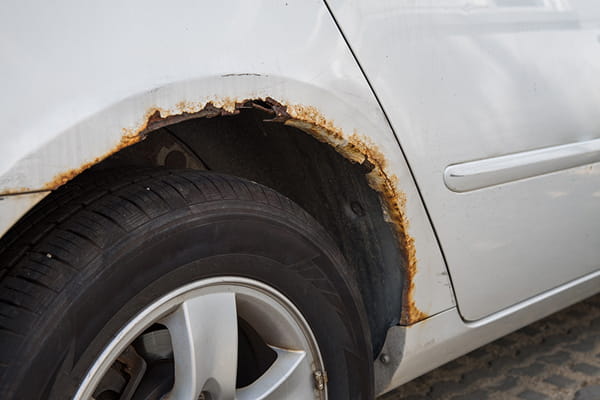
A Salt Water Damage Title Brand indicates that a vehicle was exposed to seawater or brine-contaminated floodwater. This is likely to occur during coastal storm surges, hurricanes, or when unusually high tides enter streets and parking areas. While water and cars don't mix, salt water is especially bad because the accompanying minerals and electrolytes form a more aggressive type of corrosion.
Yes, salt water accelerates rust on metal, but the problem is arguably worse with sensitive electronics. Modern automobiles are high-tech machines with dozens of computers and a sensor network. Almost every mechanical component in today's cars is accompanied by an electrical controller or monitor. More than two miles of wiring runs through these systems, making harnesses and connectors especially vulnerable to saltwater damage.
Salt, oxygen, and metal accelerate rust formation more than fresh water. Paint and undercoating protect car bodies to some extent, but corrosion can form along seams and welds. In addition, interior metal components aren't usually manufactured to withstand contact with any caustic element. This perfect storm of corrosion causes aluminum parts to oxidize, wiring to turn green and become brittle, and individual contacts inside connectors to fail.
Saltwater damage is especially dangerous with hybrid and electric vehicles. Under certain conditions, high-voltage batteries can ignite, creating a significant safety hazard, long after the water has receded.
Due to these risks, some motor vehicle agencies treat saltwater-exposed vehicles differently. A few states have a dedicated Salt Water Damage Title Brand, while others use a broader Flood or Water Damage label. Regardless of the designation, these title brands warn that the car's normal operation and safety may be compromised. Keep in mind that the Salt Water Damage Title Brand (and other title brands) is a permanent part of a car's history accessible through its vehicle identification number (VIN). No repair or clean-up can legally remove this designation.
How Does a Vehicle Get a "Salt Water Damage" Title Brand?
Issuing a Salt Water Damage Title Brand usually starts the same way: a flood event causes water to enter the engine bay or cabin. This could follow a hurricane, tropical storm, or a coastal surge. It's not unheard of for a car to be driven through brackish water at high tide.
The insurance company will step in, assuming the car has a comprehensive insurance policy and the owner submits a claim. At this point, the vehicle's damage is assessed. If repair costs exceed a specific percentage of the vehicle's value (often 70% to 90%, depending on the state), the insurer declares the car a total loss and notifies the relevant DMV. The agency will issue a branded title with the Salt Water Damage or other (like Flood) designation.
An extreme example was Hurricane Ian, which ultimately caused almost 400,000 vehicles in the Southeast U.S. to be declared total losses. These vehicles later surfaced at auctions in other states with incomplete title branding. Without a Salt Water Damage Title Brand or similar indicator, savvy car buyers had to rely on vehicle history reports to spot these cars. For example, a car registered in Florida or the Carolinas before Hurricane Ian (which occurred in late September through early October 2022) could have flood damage if it was offered for sale weeks or months later in another state.
It's essential to understand that not every car exposed to water gets a branded title. For example, just driving through standing water doesn't trigger the designation. If you're wondering what to do after driving through water, the safest approach is to have the vehicle inspected right away to check for salt or moisture intrusion before corrosion begins. The title change occurs after salt water enters the engine compartment, interior, or trunk. Regardless of how thorough the restoration process was, the residual effects of corrosion may not appear for months or years. This is the primary reason why this title brand exists: to clearly warn consumers.
Who Assigns the Title Brand & Where It's Recorded
Title branding starts at the state level because the insurance provider submits the loss information to the appropriate authority (usually the DMV). Once notification is received, the DMV issues a new, branded title. These details are sent to the federally managed National Motor Vehicle Title Information System (NMVTIS). The NMVTIS database tracks automobile thefts and title activity to protect consumers from title washing and other fraudulent activity. This information is only available to consumers through approved providers like GoodCar.
What is Title Washing?
Title washing refers to the illegal process of registering a vehicle in another state or altering documents to hide or erase a branded title. A detailed vehicle history report can help reveal when a title has been tampered with.
Here's a quick breakdown of how the title branding process usually works:
-
Insurance Declaration: Following an owner's claim, the insurance company determines if the vehicle is a total loss due to saltwater flooding.
-
State Notification: If the insurance provider accepts the claim, the DMV is notified with supporting documentation.
-
Title Reissuance: The DMV cancels the clean title and reissues one branded as Salt Water Damage (or an equivalent brand).
-
NMVTIS Update: The title brand is entered into the federal database. This designation remains with the vehicle indefinitely, regardless of whether it is registered in a different state.
-
Public Record Access: NMVTIS data is available through approved providers like GoodCar, which discloses numerous brand types, including "Salt Water Damage".
State Variations in Salt Water Damage Title Branding
Only a few states specifically reference saltwater damage in their title branding regulations; most use broader terms like "Water Damaged" or "Flood". States with distinct saltwater designations include:
State |
Brand / Designation |
Rule Summary |
|---|---|---|
Nebraska |
Salt Water Damage |
Nebraska includes "Salt Water Damage" (VTR code D) as an official brand recognized through NMVTIS. |
Vermont |
Salt Water Damage (Brand 04) |
The Vermont DMV lists "Salt Water Damage" as Brand 04, defined as "Vehicle damaged by saltwater flood". |
Washington |
Saltwater Damage |
Washington's Department of Licensing (DOL) recognizes and preserves "Saltwater Damage" entries under NMVTIS. |
Massachusetts |
Flood/Salt (SALT) (secondary brand) |
The state's Registry of Motor Vehicles (RMV) lists "Flood/Salt (SALT)" among its seven salvage sub-brands. This secondary brand applies only to salvage or owner-retained titles, not to ordinary registration titles. |
Tennessee |
Nonrepairable (salt water) / Flood Damaged (fresh water) |
Salt-submerged vehicles are permanently nonrepairable and cannot be retitled. Freshwater floods receive a "Flood Damaged" brand. |
Texas |
Salt Water Damaged → Flood Damage (Mapped*) * The state DMV substitutes a specific brand from another state into the closest matching brand in its own title system. |
TxDMV maps "Salt Water Damaged" entries to "Flood Damage" on state titles. |
Impact of a "Salt Water Damage" Title Brand
Title branding can have significant consequences for buyers and sellers. Knowing what each one means helps protect against unexpected risks.
Resale Value
Pricing in the used car market is based on condition, among other factors. A vehicle that's not in top shape is less desirable, so it's worth less. This is especially evident with branded title vehicles. Kelley Blue Book estimates these vehicles are worth 20-40% less than their clean-title counterparts.
Saltwater damage makes this worse because of the uncertainty. Can a Salt Water Damage Title Brand vehicle that's fully functioning now become a nightmare later due to spreading corrosion? Dealers will avoid purchasing these vehicles and will offer reduced trade-in prices.
Financing
Lenders are reluctant to provide financing on vehicles with less-than-clean titles. Mechanical problems and high repair bills later could cause a borrower to default on their loan. If you can locate financing, expect a higher interest rate, larger down payment requirements, and shorter terms.
Insurance
Insuring a vehicle with a Salt Water Damage Title Brand can also be challenging. Providers may be concerned that the vehicle's safety may not meet factory standards, increasing the risk of claims. Some insurance companies may only offer liability coverage and not more expansive comprehensive and collision policies. Always confirm insurance availability and pricing before purchasing a car with a branded title.
Longevity
Determining the lifespan of a car impacted by saltwater is an unanswered question. The intrusion may be minimal or substantial. Further complicating the issue is that repairs, no matter how thorough, may have missed problems that arise until much later. There are potential corrosion issues with metal components and sensitive electronics, from engine computers to safety systems. Salt intrusion is especially concerning for the high-voltage systems of hybrids and electric vehicles.
Can a "Salt Water Damage" Title Brand Be Removed?
Generally, there is no legal way to remove a Salt Water Damage Title Brand; the designation is permanent. Even after repairs and an inspection, the underlying title brand remains in the record. In these instances, some states will issue an updated "Rebuilt" or "Reconstructed" title, but that doesn't remove the original issue.
The NMVTIS database tracks title activity to prevent title washing and other illegal actions to hide a branded-title vehicle's history. Buyers should use a comprehensive vehicle history report to validate any car's background, and be alert to title brands involving saltwater and other damage.
Buyer & Seller Responsibilities
Buying or selling a car with a Salt Water (or other) Title Brand requires extra steps. Here's what's required.
Sellers
Anyone selling a vehicle with a branded title must disclose this condition before completing the transaction. While federal regulations don't specifically state that dealers have to reveal title status, several states have consumer-protection laws that mandate such disclosure. Many of these statutes apply to private sellers. Sellers should provide VIN history reports and detailed repair records to promote transparency. These steps can put buyers at ease and reduce the likelihood of post-sale complications.
Buyers
Buyers should approach vehicles with a Salt Water Damage Title Brand with extreme caution. What looks like a great deal could easily become a nightmare, even if you know the car's title status. Start with a GoodCar vehicle history report to get a complete picture; saltwater damage might not be the only issue.
If there are no surprises with the car's background, move on to an in-person inspection. You don't have to be an expert to ensure all the mechanical systems function and spot corrosion. A professional inspection should follow, offering a more thorough assessment of the vehicle's condition. Ensure insurance is available and at what cost.
Should You Buy a "Salt Water Damage" Vehicle?
There's no easy answer about buying a car with saltwater damage and a branded title. It often comes down to trading more predictable reliability for purchase savings. Here's a look at the different considerations.
Advantages
-
Low Purchase Price: Saving thousands over clean-title equivalents makes a vehicle with a Salt Water Damage Title Brand appealing.
-
Parts Value: Despite the damage, numerous components can be used on other vehicles without corrosion concerns.
-
Alternate Use: An automobile with a Salt Water Damage Title Brand may be ideal for limited uses, such as a track day car or farm vehicle.
Disadvantages
-
Unpredictable Failures: Despite thorough repairs and a detailed inspection, issues like corrosion and electrical troubles may arise after purchase. Undetected rust could later weaken safety-critical areas like subframes or mounts.
-
Limited Financing/Insurance: Financing and insurance may not be available for branded-title vehicles. At best, there may be limited options with more restrictions.
-
Poor Resale Prospects: A Salt Water Damage Title Brand may turn off future buyers, making resale challenging.
Buying Checklist
Being methodical when buying a branded-title car only helps.
VIN History Report |
Confirm the vehicle's title status and other vital background details from an NMVTIS-approved provider like GoodCar. |
Professional Inspection |
Hire a professional mechanic with experience in inspecting water-damaged vehicles. |
Electrical Evaluation |
The technician should thoroughly check all electronics, control modules, sensors, connectors, and wiring harnesses. |
Undercarriage Review |
The inspection should include a thorough examination of the suspension, frame rails, exhaust system, and brake lines for corrosion. |
Documentation Review |
Assess any records for repair thoroughness (or missing work). Have the information reviewed by an experienced mechanic. |
Insurance Confirmation |
Verify that insurance coverage is available before completing the purchase. |
Future Maintenance Plan |
Develop a budget that covers ongoing rust mitigation, including annual inspections and anti-corrosion treatments. |
Statistics & Market Data
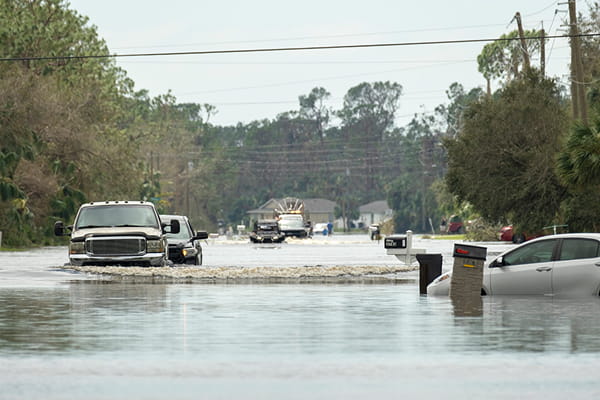
Hurricanes create the greatest risk of damaging cars through saltwater intrusion. Before Ian, Hurricanes Harvey and Irma in 2017 damaged over 637,000 vehicles, according to the National Insurance Crime Bureau (NICB).
The numbers for 2025 are still sobering. Thanks to storm damage, an estimated 45,000 vehicles had been damaged by saltwater and freshwater flooding midway through the year. Florida and Texas are the worst states for water-damaged cars, while Kentucky, Pennsylvania, and California round out the top five.
Seeing a car initially from a flood-prone state and later being sold in another state could be a red flag about its condition. Federal and state agencies warn that some of these flood-damaged vehicles re-enter the market far from the storm zone, and not always with full disclosure. Following the VIN across state lines through a vehicle history report is essential.
How to Check for Title Brands
Unlike the damage resulting from an accident or fire, the effects of saltwater immersion on a car are more complex to detect. You can't rely on sight alone. The vehicle could have been detailed and deodorized before being presented for sale, making clues harder to detect. A comprehensive VIN-based vehicle history report is vital for checking a car's title status.
A service like GoodCar compiles NMVTIS data, state DMV entries, insurance total-loss records, accident information, sales reports, and other information to provide a more complete view of a vehicle's history. It's the information you need to determine if a car has a title branded with designations like Salt Water Damage, Flood, or Water Damaged.
These are vital details because saltwater damage to cars can lead to corrosion that may take years to become an issue. A comprehensive vehicle history report is a wise investment that only takes a few minutes.
FAQs About "Salt Water Damage" Title Brand
This article provides general information about Salt Water Damage title brands. Title laws vary significantly by state and are subject to change. Always verify current requirements with your state's motor vehicle agency before purchasing branded title vehicles.
- Salt Water Damage Title on a Car: Risks & Implications
- What Is a "Salt Water Damage" Title Brand?
- How Does a Vehicle Get a "Salt Water Damage" Title Brand?
- Who Assigns the Title Brand & Where It's Recorded
- Impact of a "Salt Water Damage" Title Brand
- Can a "Salt Water Damage" Title Brand Be Removed?
- Buyer & Seller Responsibilities
- Should You Buy a "Salt Water Damage" Vehicle?
- Statistics & Market Data
- How to Check for Title Brands
- FAQs About "Salt Water Damage" Title Brand
- FREE Vehicle Search
FREE Vehicle Search
- Accidents
- Problem Checks
- Title Records
- Recalls
- Values
- Specs


-
 InfoPay, Inc. (dba GoodCar) is an Approved NMVTIS Data Provider
-

-
