


"Replica" Title Brand: What It Means for Car Buyers and Owners

- "Replica" Title Brand: What It Means for Car Buyers and Owners
- What Is a "Replica" Title Brand?
- How Does a Vehicle Get a "Replica" Title Brand?
- How States Handle the "Replica" Title Brand
- Replica vs. Kit Car vs. Reconstructed Title Brands
- Impact of a "Replica" Title Brand
- Pros and Cons of Buying a "Replica" Vehicle
- How to Identify a "Replica" Title Brand Before Buying
- FAQs About Replica Title Brands
- FREE Vehicle Search
Think of a vehicle's title history as a story of ownership, use, and sometimes misfortune. Part of the tale can involve a title brand, a designation that creates a permanent record about the car's background. This can involve a damage-based classification, such as "Salvage", or a notation identifying prior use, like "Taxi", which can negatively affect value. On the other hand, some title brands ("Antique" and "Classic", for example) may actually enhance value. Regardless of the label, title brands help buyers understand what they're buying.
A "Replica" Title Brand takes a more unique approach, specifying how the car was constructed; Replica vehicles are often built outside traditional manufacturing channels. This status provides more transparency for the buyer and can impact how the car is titled, insured, driven, and resold. We'll break down what this means because rules vary by state.
What Is a "Replica" Title Brand?
For many car enthusiasts, a 1960s-era Shelby Cobra is the ultimate dream car. However, a seven-figure price tag brings a cold dose of reality. This is when the value of a reproduction vehicle becomes apparent. It's a machine constructed to capture the look, proportions, and character of the original. Other examples mimic rare exotics, prewar coupes, and classic hot rods. Such vehicles can receive a Replica Title Brand, which tells collectors and consumers that this isn't a factory-built automobile. It functions as a disclosure rather than a negative title brand. Of course, a copy is never worth as much as the original, but a high-quality vehicle with this designation can still be valuable.
Typical Replica cars start as a collection of frames, bodies, or component packages sold by kit-car companies, specialty fabricators, or restoration shops. The parts are assembled into complete vehicles by hobbyists or professional builders. The Replica Title Brand becomes a factor because a recognized automaker like Ford or Toyota didn't produce these cars.
Sometimes, a Replica car results from combining parts from multiple donor vehicles. In these cases, a DMV applies the Replica Title Brand to make the construction history clear. In other words, the state doesn't want there to be any confusion or misrepresentation about the car, no matter how good it looks or drives.
How Does a Vehicle Get a "Replica" Title Brand?
The state issues a Replica Title Brand when a car's construction or appearance is determined to be outside normal manufacturer-issued categories. This usually occurs during titling, when the applicant submits documentation showing the construction process and the source of components. The DMV may also review whether the car qualifies under any other title classifications.
Most state motor vehicle agencies follow a similar path: the owner completes a special title application, provides verification (like receipts or ownership records), and submits the car for inspection. There may also be a review process in which an inspector evaluates the vehicle identification number (VIN), confirms that the construction qualifies as a replica-type build, and determines that no better-suited title category exists. If the qualifications for a Replica Title Brand are met, the brand designation is applied. Updates may be reflected on the title certificate or in the vehicle's VIN-based history report or both.
Some states have a more thorough inspection process than others. Extra steps may include submitting photos, completing safety or emissions checks, and verifying the VIN's location. These measures are more common with complex builds that use components from multiple sources. They help the agency confirm key construction details and prevent complications for future owners.
How States Handle the "Replica" Title Brand
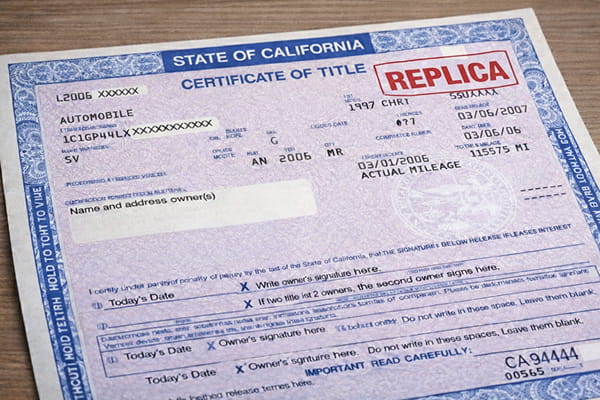
As is typical with less common title designations, there's no universal method for consistently managing the Replica Title Brand across all states. Here's an overview of the different ways select states handle the process:
-
Print "Replica" directly on the title certificate and carry the brand forward in the vehicle's digital record.
-
Using an internal designation or Brand Code 30 (Replica) recognized by the National Motor Vehicle Title Information System (NMVTIS). The notation will appear in VIN-based history reports even if the physical title shows different terminology.
-
Classifying replica-type builds under related categories, such as "Kit", "Assembled", "Reconstructed", or specially constructed vehicles.
1. States That Print "Replica" on the Title Certificate
State |
How It Uses the Replica Brand |
What Makes It a True Brand |
|---|---|---|
Florida |
Uses "Replica" on titles for vehicles assembled to resemble another model. |
Direct printed brand on title and NMVTIS Code 30 mapping. |
Missouri |
Issues certificates bearing a "Replica" brand code for vehicles constructed to mimic models at least 25 years old. |
Appears on the face of the title; tied to statutory definitions. |
Tennessee |
Titles show the word "Replica" across the front when the vehicle is a reproduction. |
Printed title brand clearly identifies replica status. |
Virginia |
State law requires titling staff to brand qualifying vehicles "Replica". |
Brand displayed on the issued certificate of title. |
Wisconsin |
Titles for replica vehicles contain the designation "Replica". |
DMV procedure explicitly applies a Replica Title Brand. |
2. States That Map to NMVTIS Brand Code 30 (Replica)
State |
How It Interacts With Replica Brand Code |
Notes |
|---|---|---|
Texas |
Conversion tables map NMVTIS Code 30 to the state's Replica classification. |
Replica may appear in internal records even when not printed. |
3. States That Recognize Replica Vehicles but Use Different Title Language
State |
How It Classifies Replica-Type Builds |
Clarification |
|---|---|---|
California |
Treats many replica vehicles as specially constructed kit vehicles. |
Replica identities acknowledged, but brand text may differ. |
Ohio |
Recognizes replica-type builds in statute but does not issue a Replica title brand. |
No indication that a Replica brand will appear on future titles. |
Why Minnesota Doesn't Belong in the Replica Title Brand Tables
Minnesota is a good example of a jurisdiction that doesn't fit into one of these categories. The North Star State doesn't issue a Replica Title Brand, even for vehicles that imitate factory-built models. Instead, all kit-built, assembled, or replica-style vehicles are branded "Reconstructed", and Minnesota reports them that way in NMVTIS.
The different approaches to branding and states like Minnesota show that Replica Title Branding is far from uniform. Be alert to these differences if Replica is on your shopping list. We'll get into identifying these cars later.
Replica vs. Kit Car vs. Reconstructed Title Brands
Buyers may come across labels like Replica and Kit Car and incorrectly think they're the same. Add other terminology into the mix, like Reconstructed or Antique, and it's easy to get overwhelmed, mainly because individual DMVs apply their own definitions.
However, states have specific reasons for slicing these categories so finely. Vehicles built outside assembly-line conditions don't fall neatly into one box. Some are faithful recreations of a particular model; others are general-purpose kits; still others are rebuilt from older vehicles with no intention of mimicking a historic car. These classifications affect taxes, safety standards, emissions requirements, and long-term title history.
Replica Title Brand
As mentioned, a Replica Title Brand applies to a vehicle that emulates a particular model. The Shelby Cobra is one example. Professionally built Replicas exist for the Ford GT40 and Porsche 550 Spyder, among numerous others. If it's exotic and expensive, chances are someone has tried to duplicate it. The defining factor for this brand is a physical resemblance to an existing model.
Kit Car Title Brand
A kit car is assembled from components sold without a complete donor vehicle. A specific model may inspire the final product, but this isn't always the case. The beauty of many kit cars is their flexibility. Builders can choose drivetrain layouts, body styles, and interior designs without trying to match a recognizable vehicle.
Reconstructed Title Brand
The Reconstructed Title Brand is associated with a car that's been rebuilt due to damage or disassembly, often after a significant accident. Although some states may use this brand to categorize a Replica car, it's more associated with vehicles rebuilt to working condition.
Antique/Classic Titles
These categories apply only to genuine vintage vehicles, not reproductions. Factory Five's Hot Rod may look like the iconic Ford Deuce Coupe from the 1930s, but it will never qualify as an Antique or Classic with DMVs that require manufacturer originality.
Impact of a "Replica" Title Brand
There are real-world considerations with owning a Replica Title Brand vehicle. The worry doesn't involve the adverse perceptions of a title brand such as Salvage or Rebuilt, which drive down value. Instead, these issues are practical ones, like registering and insuring the car.
Registration
Some states require Replica cars to undergo the same emissions inspections as standard automobiles. In addition, the vehicle may be subject to a safety review to ensure its roadworthiness or be subject to different registration rules.
Financing
Don't expect to find financing for a Replica car through a traditional finance company. The issue isn't the title brand as much as it's a non-standard vehicle, which makes valuation challenging. Financing might be available through a specialty lender or by taking out a personal loan that doesn't require collateral.
Insurance
Like with financing, obtaining insurance for a one-off vehicle requires extra legwork. You'll likely need to secure coverage with a specialty insurer that focuses on classic cars and other unique vehicles. You may be limited to liability-only coverage.
Resale Value
It can be difficult to pin down the resale value of a Replica car. While there are pricing indexes for modern and vintage vehicles, such information doesn't usually exist for one-offs and hand-built automobiles. The value depends on collector interest, construction quality, and resemblance to a highly sought-after original car.
Pros and Cons of Buying a "Replica" Vehicle
Replica cars aren't for everyone. They target a specific audience who want the look of an iconic vehicle without the eye-popping price or worry about driving an irreplaceable classic. Here are the advantages and drawbacks to consider:
Pros |
Cons |
|---|---|
Attracts attention like the original |
Not the real thing |
More affordable than genuine classics or exotics |
Build quality is dependent on the components used and the assembler's skill |
Customizable, depending on the build |
Limited insurance and financing options |
Better reliability when equipped with modern components |
Restricted resale market is concentrated on enthusiasts |
How to Identify a "Replica" Title Brand Before Buying
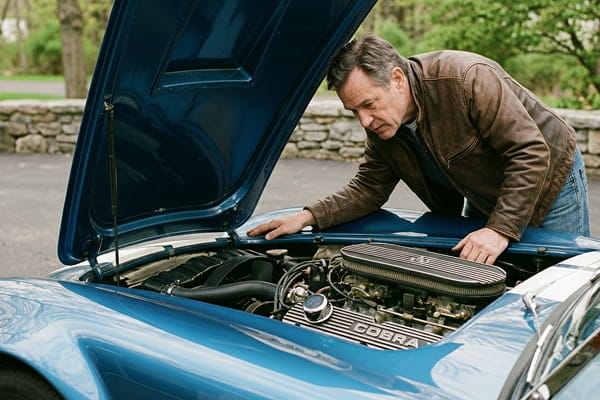
Even if you're comfortable checking out a used car, evaluating a Replica Title Brand vehicle requires a different approach. Remember, this isn't a factory-built car.
Start by reviewing the paperwork:
-
Check the title for wording like Replica, Reproduction, Specially Constructed, or Assembled Vehicle, depending on the state's branding terminology.
-
Order a VIN-based vehicle history report from GoodCar to verify the car's background and check for other title brands (like Rebuilt or Salvage) that may impact value.
-
Review build documentation, including receipts for major components, donor-vehicle records, and any DMV inspection reports.
Then look closely at the vehicle itself:
-
Inspect the construction, noting features such as fiberglass or composite bodywork, aftermarket chassis plates, or non-standard VIN placements.
-
Look for signs of kit assembly, including mismatched welds, custom brackets, or tags from kit-car manufacturers.
-
Verify the VIN, ensuring it matches the paperwork and is placed in an expected location.
Make note of any red flags, like missing documentation or questionable build quality. You might find it helpful to bring an experienced mechanic to double-check your findings and perform a thorough mechanical inspection before purchase.
FAQs About Replica Title Brands
State laws on replica vehicles vary. Always verify the current requirements with your local motor vehicle agency, as this article provides only a general overview.
- "Replica" Title Brand: What It Means for Car Buyers and Owners
- What Is a "Replica" Title Brand?
- How Does a Vehicle Get a "Replica" Title Brand?
- How States Handle the "Replica" Title Brand
- Replica vs. Kit Car vs. Reconstructed Title Brands
- Impact of a "Replica" Title Brand
- Pros and Cons of Buying a "Replica" Vehicle
- How to Identify a "Replica" Title Brand Before Buying
- FAQs About Replica Title Brands
- FREE Vehicle Search
FREE Vehicle Search
- Accidents
- Problem Checks
- Title Records
- Recalls
- Values
- Specs


-
 InfoPay, Inc. (dba GoodCar) is an Approved NMVTIS Data Provider
-

-
