


"Gray Market" Title Brands: Compliant vs. Non-Compliant Vehicles
- "Gray Market" Title Brands: Compliant vs. Non-Compliant Vehicles
- What Are "Gray Market" Title Brands?
- "Gray Market: Non-Compliant" Title Brand
- "Gray Market: Compliant" Title Brand
- Who Assigns "Gray Market" Title Brands and Where They're Recorded
- How States Handle "Gray Market" Title Brands
- Impact of "Gray Market" Title Brands
- Should You Buy a "Gray Market" Vehicle?
- FAQs About "Gray Market" Title Brands
- FREE Vehicle Search
The typical used car shopper may only think about a vehicle title when it's time to transfer ownership and register the vehicle. However, paying attention to this record before money changes hands can reveal a title brand. This designation can alert buyers to a significant condition or history connected to the car. Issued by a state motor vehicle agency, these classifications alert consumers by preserving transparency, even if the automobile changes hands multiple times or is registered in another state.
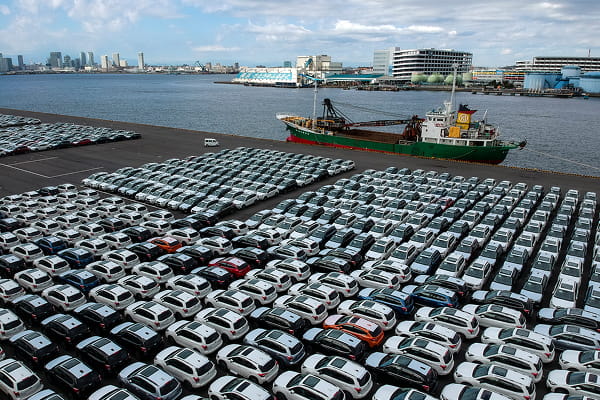
You may already be aware of more common title brands, like "Salvage", "Rebuilt", or "Flood". However, there are dozens of other categories, including "Gray Market" title brands. These designations don't reflect an accident history or other damage, but instead identify vehicles manufactured for sale outside the United States and later brought back to the country outside an authorized distribution network.
Importantly, gray market branding focuses on compliance, not condition. These designations indicate whether an imported car complies with U.S. safety and emissions regulations or may face legal restrictions. It's a distinction that every buyer must know. A gray market car may drive fine and look good, but can be impossible to register and may not be legal to drive on public roads.
The National Motor Vehicle Title Information System (NMVTIS) uses two brand codes to track gray market vehicles across state lines. NMVTIS Brand Code 45 identifies a gray market vehicle that is not compliant with U.S. standards, while NMVTIS Brand Code 46 identifies a gray market vehicle that is compliant.
Notably, how these codes appear, or whether they appear at all, depends on how each state chooses to handle gray market branding. Some DMVs have their own terminology to handle these types of automobiles.
What Are "Gray Market" Title Brands?
As mentioned, "gray market" refers to vehicles built for sale outside of the U.S. and then imported into the country by a third party, not the manufacturer. These cars may be built to other standards. There could be visual differences, such as with the bumpers and lighting. Or, the vehicle may look identical to models sold to Americans, but still be non-compliant in other ways (such as with safety and emissions).
Even vehicles built in the U.S. and sold overseas could fall into the gray market category when reimported into the country. For example, every Jeep Wrangler sold worldwide is manufactured in Toledo, Ohio. However, not every example is built to U.S. standards. Such Wranglers, when returned to the U.S., might not meet American safety and emissions regulations.
The main reasons for gray market branding are disclosure and consumer protection. These classifications allow buyers, states, and third parties (such as dealers, lenders, and insurers) to quickly determine whether an imported vehicle complies with U.S. Department of Transportation (DOT) and Environmental Protection Agency (EPA) regulations. Without this information, a car never intended for the U.S. market could be sold to unsuspecting buyers through normal resale channels.
Compliance, or lack thereof, directly affects ownership, resale value, and drivability on public roads. A compliant gray market vehicle may be legally titled, registered, insured, and resold, though it still carries a permanent disclosure. The same may not be said for a non-compliant car. These automobiles may be limited to off-road use or for export-only purposes. Legal registration may not even be an option.
Buyers should be aware that gray market title brands aren't temporary. Even if an imported vehicle is compliant or later modified to be compliant, the designation is a permanent part of the car's history. Any subsequent sale or retitling, even in another state, won't remove this information.
"Gray Market: Non-Compliant" Title Brand
It's critical to recognize the distinctions between the two classifications that cover gray market vehicles. The Gray Market: Non-Compliant Title Brand (NMVTIS Brand Code 45) applies to a vehicle that doesn't comply with federal safety and emissions regulations. These are complex statutes that fall under the Federal Motor Vehicle Safety Standards (FMVSS), administered by the National Highway Traffic Safety Administration, and the Clean Air Act, overseen by the EPA.
Non-compliance is often the result of the vehicle not having certification that required modifications were performed and approved. These changes can be substantial, often involving lighting systems, crash protection components, emissions controls, and onboard diagnostics. Without compliance records, a DMV may treat the vehicle as ineligible for normal registration.
In many cases, the car can't be legally driven on public roads because it won't qualify for standard registration until compliance is documented. Use is often restricted to off-road driving, racing, displays, or export outside the U.S. Additionally, some states make such vehicles ineligible for titling or registration until compliance can be proven.
Despite these limitations, non-compliant gray market vehicles do appear in the resale market, usually at steep discounts. Ethical sellers will disclose the reason for the low price, but it's best not to make assumptions. Some buyers may believe they've encountered a bargain because of a mechanical or cosmetic issue, only to discover problems later when trying to register or insure the car.
"Gray Market: Compliant" Title Brand
The Gray Market: Compliant Title Brand, NMVTIS Brand Code 46, indicates an imported vehicle that complies with applicable U.S. statutes. In theory, the car could already be compliant upon entering the country, but modifications and a certification process are often involved.
Compliance is usually arranged through an NHTSA-approved Registered Importer (RI). The RI is responsible for arranging the required modifications and providing documentation to support certification. EPA compliance may also be necessary, depending on the vehicle's age and configuration.
The vehicle can be titled and registered for public road use once compliance is verified. However, the gray market designation remains. While a compliant gray market vehicle is worth more than a comparable non-compliant one, ownership may still be challenging. There may be fewer options for obtaining financing and insurance.
Who Assigns "Gray Market" Title Brands and Where They're Recorded
State motor vehicle agencies, not manufacturers or the federal government, assign gray market title brands. DMVs use import documentation provided at the time of titling, which may include records from U.S. Customs and Border Protection, NHTSA, the EPA, and Registered Importers.
Once applied, gray market branding is recorded in multiple places. In some jurisdictions, the designation appears on the printed title certificate and in the state's digital title records. In other states, the information is only tracked electronically. Each state then transmits the title brand to NMVTIS. Vehicle history report providers that rely on NMVTIS data may also display gray market branding, depending on how the state reports it.
Because each DMV agency has discretion over how it applies and displays title brands, gray market status may appear differently across states. This variation makes it especially important for buyers to review state title records and NMVTIS-based vehicle history reports.
How States Handle "Gray Market" Title Brands
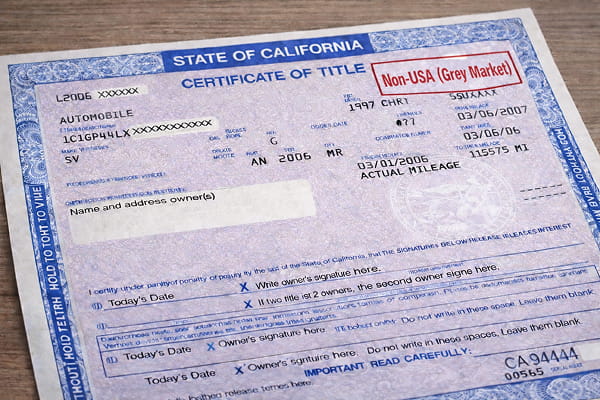
There's significant variation in how state motor vehicle agencies apply and record gray market title branding. Some explicitly print gray market or use Non-USA terminology. Others recognize NMVTIS brand codes without publishing a consumer-facing brand. Yet, some DMVs take a looser approach without establishing a defined title label. Here's a look at the practices of select states:
Use of Explicit Brand Titles
State |
Title Brand Language Used |
Notes |
|---|---|---|
California |
"Non-USA (Grey Market)" |
Applied to vehicles manufactured for sale outside the U.S. and later imported; appears as explicit branded title language. |
Idaho |
"Gray Market Vehicle" / "Gray Market Non-Compliance" |
Administrative rules and DMV policy recognize gray market branding tied to federal compliance status. |
Nevada |
"Non-US Vehicle" |
Nevada brands imported vehicles as "Non-US Vehicle", explicitly identifying gray-market imports. |
New York |
"NON-USA-STD" |
Used for vehicles not originally manufactured to U.S. safety and emissions standards. |
North Carolina |
"Non-U.S.A. Vehicle" |
Title reflects non-U.S. origin once the compliance documentation is reviewed. |
Texas |
"Gray Market" |
Texas recognizes gray market determinations and may restrict titling/registration unless compliance documentation is provided. |
Vermont |
"Gray Market Non-Compliance" / "Gray Market" |
Vermont lists a legacy Gray Market brand (Code 22) and notes it was replaced by NMVTIS-aligned brands 45 and 46; Vermont also carries forward existing brands when titles transfer in. |
Wisconsin |
"Non-USA Standard" / "Prior Non-USA" |
Wisconsin brands vehicles not originally manufactured to U.S. federal standards. |
NMVTIS Gray Market Codes Handled Procedurally
State |
NMVTIS Recognition |
Notes |
|---|---|---|
Florida |
NMVTIS Codes 45 & 46 listed as "GREY MARKET" |
Recognized in FLHSMV title procedures; codes are acknowledged at the NMVTIS level but not clearly presented as consumer-facing title brands. |
Gray Market Vehicles Addressed Without a Defined Title Brand
State |
Guidance Language |
Notes |
|---|---|---|
Delaware |
Gray market / foreign-market vehicle guidance |
DMV materials discuss imported vehicles and federal compliance issues, but don't define a specific gray-market title brand. |
Impact of "Gray Market" Title Brands
Prospective buyers should have a thorough understanding of what's involved in owning a vehicle with a gray market title brand. However, the severity of the consequences depends on whether the car is compliant or non-compliant.
Resale Value
Because modifications and certification have already been completed, a compliant gray market vehicle will be worth more than a similar car with non-compliant status. Nonetheless, a gray market vehicle that's legal to drive on public streets will still have a lower resale value than an equivalent clean title example.
Financing
Gray market vehicles may be difficult to finance due to valuation uncertainty. This is even more of an issue with non-compliant cars because of unknown compliance costs.
Insurance
Insurance available varies by provider. Some companies may decline to insure any type of gray market vehicle, while others will only cover cars that can be registered and driven on public roads. Premiums may be higher, or coverage options may be limited.
Registration
In most cases, only compliant gray market vehicles are eligible for registration and use on public streets.
Should You Buy a "Gray Market" Vehicle?
There are definite advantages to purchasing a gray market vehicle, but they should be weighed against potential risks.
Pros |
Cons |
|---|---|
|
|
For most buyers, a compliant gray market vehicle is usually less risky than a non-compliant one, but neither should be purchased without thorough research and verification.
Buyer Checklist
Purchasing a gray market vehicle requires several steps before proceeding with a transaction:
-
Check the title document for any gray market branding.
-
Order a title report from the DMV to double-check branding details.
-
Obtain a comprehensive vehicle history report that uses NMVTIS data to validate title brands and check for other critical records.
-
Review compliance documentation for a compliant vehicle, including NHTSA Registered Importer paperwork (when applicable).
-
Confirm emissions compliance documentation where required (EPA-related paperwork may be relevant depending on vehicle age/configuration).
-
Confirm with the DMV that the car can be titled, registered, and is legal to drive on public roads (for a compliant vehicle).
-
Verify availability and cost for insurance.
-
Have a qualified mechanic conduct a thorough pre-purchase inspection.
FAQs About "Gray Market" Title Brands
States apply and interpret gray market title branding differently, and requirements can shift over time. Before proceeding with a purchase or sale, confirm how your state currently handles titling and registration of imported vehicles.
- "Gray Market" Title Brands: Compliant vs. Non-Compliant Vehicles
- What Are "Gray Market" Title Brands?
- "Gray Market: Non-Compliant" Title Brand
- "Gray Market: Compliant" Title Brand
- Who Assigns "Gray Market" Title Brands and Where They're Recorded
- How States Handle "Gray Market" Title Brands
- Impact of "Gray Market" Title Brands
- Should You Buy a "Gray Market" Vehicle?
- FAQs About "Gray Market" Title Brands
- FREE Vehicle Search
FREE Vehicle Search
- Accidents
- Problem Checks
- Title Records
- Recalls
- Values
- Specs


-
 InfoPay, Inc. (dba GoodCar) is an Approved NMVTIS Data Provider
-

-
